Enhancing Smart City Infrastructure Management through Centralized IoT Edge Control
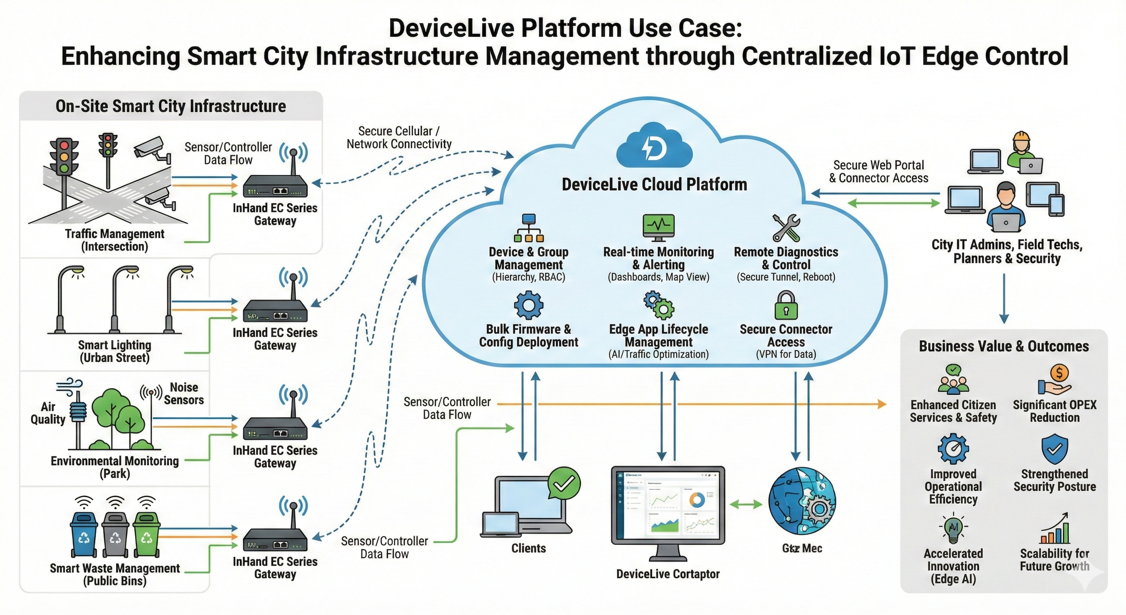
A rapidly growing smart city deploys thousands of IoT devices across its urban landscape to manage critical infrastructure: intelligent street lighting systems, environmental monitoring stations (air quality, noise), traffic signal controllers, and smart waste management sensors. These devices are connected via InHand Networks' EC series edge gateways. The city's IT department faces significant hurdles:
- Scale & Complexity: Managing thousands of geographically dispersed devices across diverse infrastructure types is operationally overwhelming.
- Resource Constraints: Limited IT staff must efficiently monitor, maintain, and update a vast array of devices without dedicated on-site personnel at every location.
- Network Diversity & Reliability: Devices connect via various networks (cellular, Wi-Fi, wired Ethernet), with varying levels of reliability and bandwidth, impacting remote management capabilities.
- Security Imperative: Protecting sensitive citizen data (e.g., from traffic cameras, environmental sensors) and ensuring secure access to city infrastructure is paramount.
- Demand for Rapid Innovation: The city needs to quickly deploy and manage new smart city applications at the edge to address evolving citizen needs and service improvements.
2. Solution: DeviceLive as the Unified Smart City Management Nervous System
The city implements DeviceLive as its central cloud platform for managing all InHand edge gateways and, by extension, the connected smart city IoT devices. DeviceLive provides the essential tools for secure, scalable, and efficient remote operations.
3. Implementation & Key Operational Workflows
Unified Onboarding & Organizational Structure:
- InHand gateways are installed at each smart infrastructure site (streetlight cluster, traffic intersection, waste bin cluster, environmental station).
- Gateways automatically connect to DeviceLive upon network availability (leveraging secure bootstrapping methods).
- City IT administrators organize devices within DeviceLive using a logical hierarchy reflecting the city's geography and infrastructure types (e.g., "Downtown > Traffic Management," "Residential Area West > Smart Lighting," "Parks > Environmental Sensors").
- User Roles (City Admin, Infrastructure Manager, Field Technician, Security Officer) are strictly defined to enforce the principle of least privilege.
Proactive Health Monitoring & Alert-Driven Response:
- The central IT team uses DeviceLive's Overview Dashboard and Map View for a constant, real-time pulse on the entire smart infrastructure:
- Gateway online/offline status and network health (Signal Strength, Latency, Data Usage).
- Aggregated device status (e.g., % of streetlights operational, traffic signal controller health).
- Critical environmental readings (e.g., Air Quality Index spikes).
- Custom Alert Rules are configured for critical events impacting citizen services or safety:
- "Streetlight Cluster Offline" (Impacting public safety at night).
- "Traffic Signal Controller Fault" (Causing potential traffic disruption).
- "Waste Bin Full Level Exceeded" (Triggering optimized collection routes).
- "Air Quality Sensor Reading Critical" (Requiring immediate investigation).
- "Gateway Network Disconnect" (Indicating potential vandalism or network outage).
- Alerts are routed via Email, SMS, and integrated into the city's IT ticketing system, providing context and device location.
Secure Remote Diagnostics & Control:
- Upon a "Traffic Signal Controller Fault" alert, a field technician uses DeviceLive's Remote Access to securely connect to the gateway at the affected intersection. From there, they can access the controller's local interface to diagnose the fault (e.g., software glitch, configuration error) and often resolve it remotely via Remote Commands (e.g., Reboot Controller, Restore Configuration).
- For a "Streetlight Cluster Offline" alert, the technician checks Connection History and Cellular Signal data in DeviceLive to determine if it's a network issue or a gateway/power fault, guiding the dispatch decision.
Efficient Bulk Configuration & Firmware Management:
- A critical security patch is released for all traffic signal controller gateways. Using DeviceLive Groups (e.g., "All Traffic Gateways"), the IT admin deploys the Firmware Upgrade to all relevant devices simultaneously. DeviceLive manages the rollout intelligently, allowing staggered updates to avoid overloading networks or controllers.
- A new configuration standard for smart lighting (e.g., adaptive dimming schedules based on time/day) is developed. This configuration is pushed to all relevant Groups of lighting gateways using DeviceLive's Configuration Management, ensuring city-wide consistency instantly.
Edge Application Deployment & Management (Smart City Innovation):
- The city develops a new AI application for optimizing traffic light timing based on real-time flow data, designed to run on the EC gateways at intersections.
- Developers package the application.
- Using DeviceLive's Project Management within the "Traffic Management" device Group, the new application version is deployed. DeviceLive handles the secure distribution, installation, version control, and lifecycle management (start/stop/update/delete) of this edge AI application across all target gateways, enabling rapid innovation.
Secure Remote Access for Diverse Users (Connector):
- A city planner needs temporary access to data from environmental sensors in a specific park for a report. Instead of granting direct DeviceLive access, an IT admin sets up a Connector network. The sensor gateway is added as a device, and the planner's laptop is configured with the Connector client. This creates a secure, temporary VPN tunnel, allowing the planner to access only the specific sensor data endpoints defined, without full platform access.
4. Achieved Benefits & Value Proposition
- Enhanced Citizen Services & Safety: Faster response to infrastructure faults (lighting, traffic signals) improves public safety and reduces disruption. Optimized services (waste collection, traffic flow) enhance citizen satisfaction.
- Significant OPEX Reduction: Elimination of countless truck rolls for routine checks, minor troubleshooting, and configuration updates saves substantial taxpayer money.
- Improved Operational Efficiency: Centralized monitoring and bulk operations free up IT staff for strategic initiatives instead of firefighting.
- Strengthened Security Posture: Robust security features (MFA, RBAC, secure tunnels, encrypted communications) protect critical city infrastructure and citizen data.
- Accelerated Innovation: Easy deployment and management of new edge applications enable the city to rapidly implement new smart city services and improve existing ones.
- Scalability for Future Growth: DeviceLive provides a future-proof platform to seamlessly integrate and manage the addition of thousands more smart city devices as the city expands.
Topic Participants
david.jing