Optimizing Renewable Energy Grid Integration with Remote Edge Management
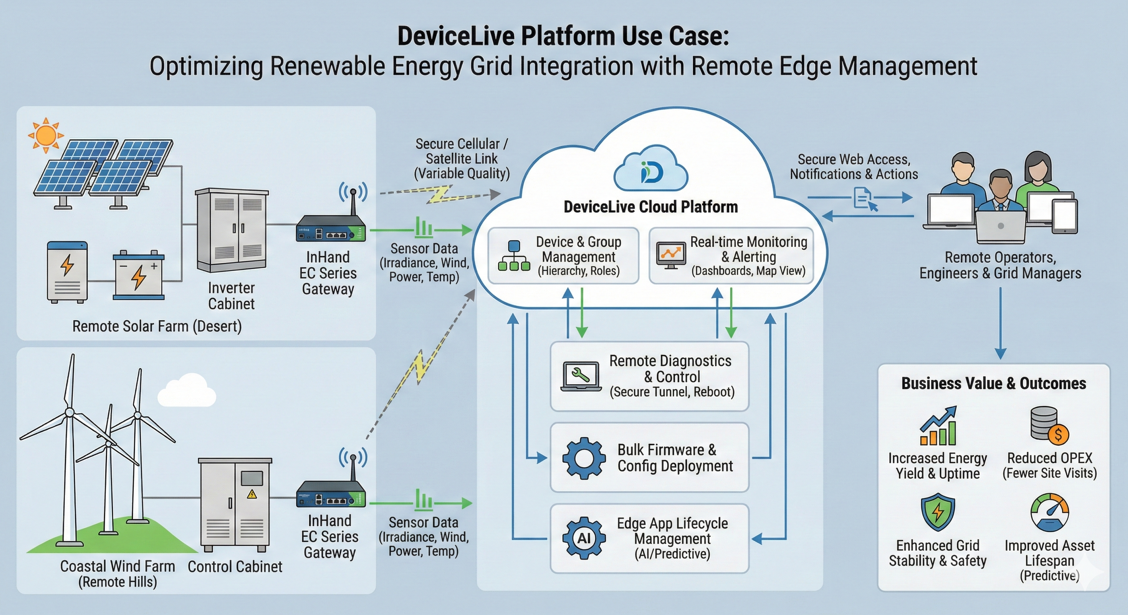
A renewable energy provider operates hundreds of solar and wind farms spread across diverse geographical locations (deserts, coastal areas, remote hills). Each site utilizes edge computing gateways (InHand EC series) to aggregate data from numerous sensors (solar irradiance, wind speed, temperature, inverter status, power output) and control equipment (inverters, transformers, battery storage). Key challenges include:
- Site Dispersion & Accessibility: Many sites are in hard-to-reach areas, making physical visits for maintenance or configuration changes costly and time-consuming.
- Network Instability: Remote sites often rely on cellular connections prone to fluctuations or outages, impacting data transmission and remote control.
- Real-time Performance Monitoring: Ensuring optimal energy production and grid stability requires constant, real-time monitoring of equipment health and power flow across all sites.
- Rapid Response to Anomalies: Detecting and mitigating issues like equipment malfunction, underperformance, or grid instability events quickly is critical to minimize energy loss and prevent damage.
- Secure Remote Configuration: Safely updating control logic or sensor calibration parameters remotely across numerous devices is essential for operational efficiency.
2. Solution: DeviceLive Cloud Platform with InHand Edge Gateways
The energy provider implements DeviceLive as its central IoT management platform. InHand EC series gateways are deployed at each solar/wind farm site, acting as the secure bridge between local sensors/equipment and the DeviceLive cloud.
3. Implementation & Key Workflows
Seamless Onboarding & Organization:
- Gateways are pre-configured with DeviceLive connection details at the factory or during initial site setup.
- Upon first power-up and network connection, gateways automatically discover and connect to DeviceLive using secure protocols (TLS).
- Administrators organize devices within DeviceLive using a hierarchical structure reflecting geographical regions (e.g., "North America > Southwest > Desert Solar Farm 1") and site types (Solar, Wind).
- Granular User Roles are assigned (e.g., Regional Manager, Site Engineer, Grid Operator) to control access to specific sites and functions.
Robust Remote monitoring & Alerting:
- Operators use the DeviceLive Overview Dashboard and Map View for instant visibility into the operational status (Online/Offline), network health (Cellular Signal Strength, Data Usage), and critical KPIs (Total Power Output, Grid Frequency) of all sites.
- Custom Alert Rules are configured for critical events:
- "Gateway Disconnected" (Triggering immediate investigation of network issues).
- "Inverter Fault" or "Underperformance" (Detected by analyzing sensor data trends).
- "Grid Frequency Deviation" (Indicating potential instability).
- "High Temperature" (Risk of equipment damage).
- Alerts are sent instantly via Email and SMS to the relevant on-call engineers or grid operators, including device location and initial diagnostic data.
Remote Diagnostics & Control (Over Unstable Networks):
- Upon receiving a "Gateway Disconnected" alert, a technician uses DeviceLive's Connection History and Cellular Signal graphs to diagnose if the issue is a temporary network blip or a gateway fault.
- If safe to do so, the technician can attempt a Remote Reboot of the gateway via DeviceLive.
- For deeper diagnostics on a specific inverter showing faults, the technician uses Remote Access (secure tunnel) to log into the gateway's local interface or directly access the inverter's web console (if exposed via the gateway's local network and configured as an Endpoint in a Connector setup).
Bulk Configuration & Firmware Management:
- A new firmware update for the gateways, improving cellular handover stability, is released.
- An administrator uses DeviceLive's Group functionality to target all gateways in the "Coastal Wind Farms" group.
- The Firmware Upgrade feature is used to deploy the update. DeviceLive intelligently manages the rollout, allowing administrators to choose immediate upgrade for online devices or schedule for off-peak hours. Offline devices receive the update upon reconnection.
- Similarly, configuration changes (e.g., adjusting sensor sampling rates, updating control parameters for battery storage) are developed once and pushed to relevant Groups of devices using Configuration Management.
Edge Application Management (For Advanced Analytics):
- The energy provider develops a new AI-based application for predictive maintenance on wind turbine gearboxes, running directly on the EC gateways at the wind farms.
- Developers package the application and its dependencies.
- Using DeviceLive's Project Management within the relevant device Groups, the new application version is deployed and managed centrally. DeviceLive handles distribution, installation, version control, and lifecycle management across all target edge devices.
4. Business Value & Outcomes
- Increased Energy Production & Uptime: Proactive detection and remote resolution of issues significantly reduce downtime and optimize performance, leading to higher overall energy yield.
- Reduced Operational Costs (OPEX): Dramatic reduction in the need for costly and slow physical site visits for routine checks, troubleshooting, and configuration updates.
- Enhanced Grid Stability & Safety: Faster response to grid instability events and equipment faults minimizes risks and ensures compliance with grid codes.
- Improved Asset Lifespan: Predictive maintenance enabled by edge analytics and remote monitoring helps prevent catastrophic failures and extends equipment life.
- Scalability & Agility: DeviceLive provides a single pane of glass to manage an ever-growing number of dispersed renewable energy sites efficiently, supporting business expansion.
- Optimized Network Usage: Intelligent handling of firmware/config updates over cellular networks minimizes data costs.
Topic Participants
david.jing