Use Case: 5G Empowering Smart & Efficient Operations for Pop-up Stores
Background
As a vital format in "New Retail," Pop-up Stores (Flash Stores) have become a core scenario for brand marketing due to their flexible deployment and high interactivity. Meanwhile, with the maturity of 5G technology and extensive base station coverage penetrating deep into commercial and residential areas, the infrastructure is ready for next-generation retail.
Challenges
Rapid Deployment Required: Pop-up stores are often located in temporary spaces like mall atriums or outdoor plazas. Networking must be completed within 24 hours, making traditional wired fiber solutions difficult and impractical to install.
High Network Stability: During peak hours, multiple services run concurrently, including POS systems and Guest Wi-Fi. Legacy 4G networks often lack sufficient bandwidth, leading to order transmission delays and payment failures.
Remote Management: Store locations are scattered, and the lack of a unified O&M (Operations & Maintenance) tool makes troubleshooting time-consuming and costly.
Solution: The 5G CPE02 High-Speed Connection
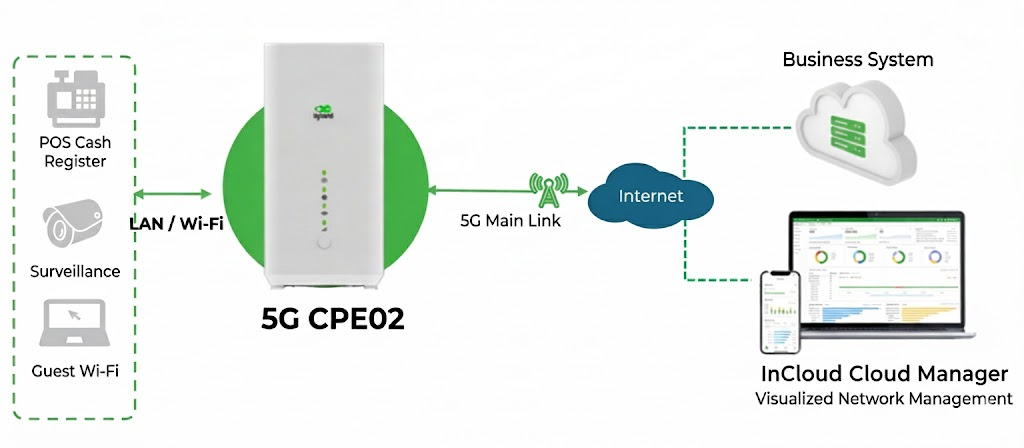
Deploying the 5G CPE02 as the central network hub for the store creates a "Payment Priority + Experience Enhancement" dual-engine system.
- Full 5G Coverage & Plug-and-Play:The solution utilizes dual-mode 5G full-frequency coverage. It requires no cabling—simply plug and play. This solves signal blind spot issues caused by complex location geography, ensuring consistent network stability across all chain branches.
- Cloud Management Platform for Simplified O&M:The "Star Cloud Manager" platform provides a visualized dashboard showing traffic usage, signal strength, and device status across all stores. It automatically alerts administrators to SIM card anomalies or antenna failures.
- End-to-End Encryption for Payment Security:The 5G CPE02 supports firewalls with blacklist/whitelist filtering and domain filtering. It is configured to prioritize POS system traffic (QoS), blocking risky connections to guarantee the continuity and security of financial transactions.
Topic Participants
Irene Peng