Use Case: Car Rental Fleet Management & UBI (Usage-Based Insurance)
 1. Scenario Background
A car rental agency with a fleet of passenger vehicles faces high operational risks and costs.
Challenges:
Reckless Driving: Customers often drive rental cars aggressively (speeding, harsh braking), increasing wear and tear and accident risks.
Billing Accuracy: Manually checking fuel levels and mileage at return is time-consuming and prone to disputes.
Theft: High-value vehicles need protection against theft or being driven across unauthorized borders.
Accident Liability: Determining fault in accidents is difficult without objective data.
2. Solution Overview
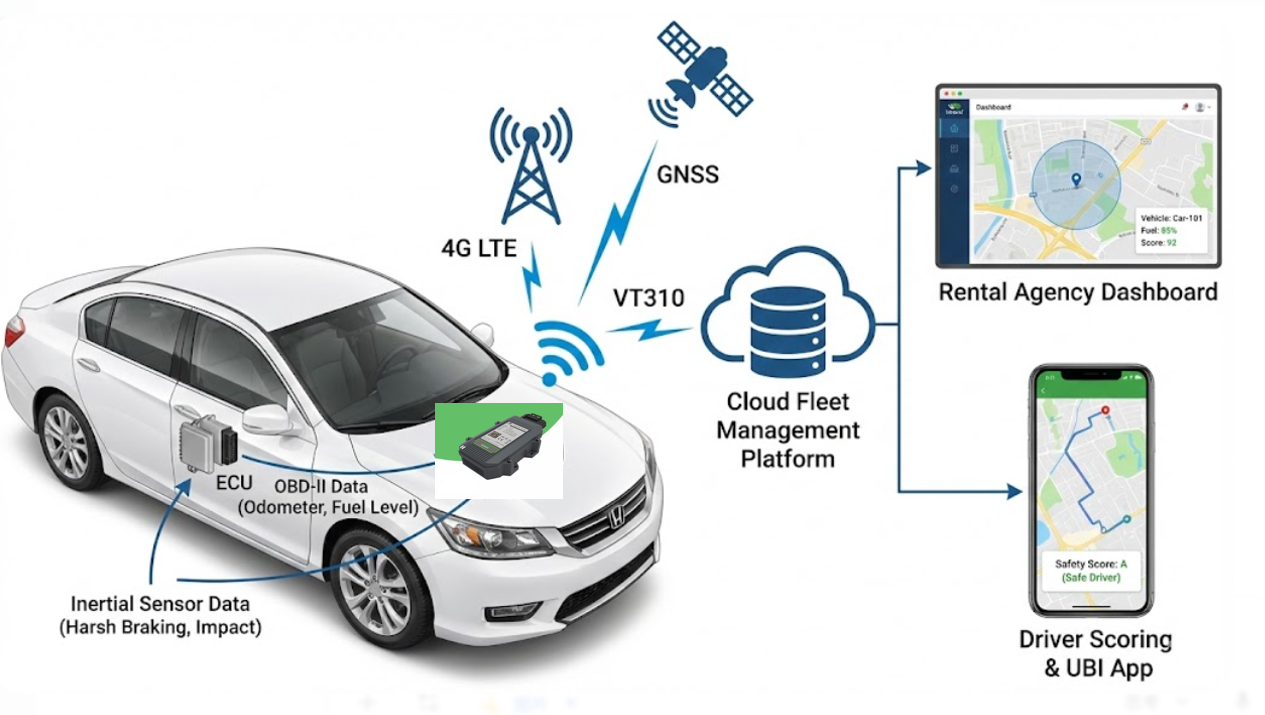
The InHand VT310 is plugged directly into the OBD-II port of every rental car. It serves as a "Black Box," continuously monitoring vehicle health, driver behavior, and location to protect the asset and automate billing.
3. Implementation Details
Step 1: Automated Return & Billing (OBD-II)
Data Integration: The VT310 connects via the standard OBD-II interface. It reads the vehicle's real-time odometer and fuel level percentage directly from the ECU.
Workflow: When a customer returns the car, the system automatically generates a bill based on the exact distance driven and fuel consumed, eliminating manual checks.
Step 2: Driver Behavior Monitoring (UBI)
Sensor Analysis: Utilizing the built-in gyroscope and inertial sensors (accelerometer), the VT310 detects dangerous driving events such as sudden acceleration, hard braking, and sharp cornering.
Risk Scoring: This data is sent to the cloud to generate a "Driver Safety Score." The rental agency can blacklist risky drivers or offer discounts to safe drivers (Usage-Based Insurance model).
Step 3: Security & Border Control
Geofencing: The agency sets up geofences around the city or country borders. If a vehicle crosses a restricted boundary, the VT310 sends an immediate alarm via LTE.
Remote Immobilization: In a verified theft scenario, operators can trigger the Digital Output (DO) to cut the ignition power, safely disabling the vehicle once it stops.
Step 4: Crash Detection & Reconstruction
Impact Alert: The inertial sensor is configured to detect high-G impacts (collisions). In the event of an accident, the device instantly uploads a high-priority alert with location and timestamp.
Data Logging: The device stores the "second-by-second" telemetry leading up to the crash, helping insurance adjusters determine the cause.
4. Customer Benefits
Reduced Wear & Tear: Discouraging aggressive driving extends the life of brakes, tires, and engines.
Operational Efficiency: Automated mileage and fuel reading speeds up the check-out/check-in process.
Asset Recovery: High-precision GNSS and remote control features ensure stolen vehicles are recovered quickly.
Evidence-Based Claims: Objective crash data simplifies insurance claims and liability assessments.
Topic Participants
david.jing