Use Case: Remote Monitoring and Control of Water Pump Stations
1. Scenario Background
A water management company manages multiple sewage lifting stations and clean water pump stations located in remote, scattered areas. These sites operate in harsh environments and are often unmanned. The company faces the following challenges:
Wiring Difficulty: Many sites are in rural or difficult-to-reach locations where laying wired networks (fiber/copper) is too expensive or impossible.
Device Management: They need to monitor the status of pumps, water levels, and power supplies in real-time.
Emergency Control: In case of emergency (e.g., water level exceeding the limit), they need to remotely trigger alarms or stop equipment immediately.
Data Security: Critical infrastructure data requires encrypted transmission.
2. Solution Overview
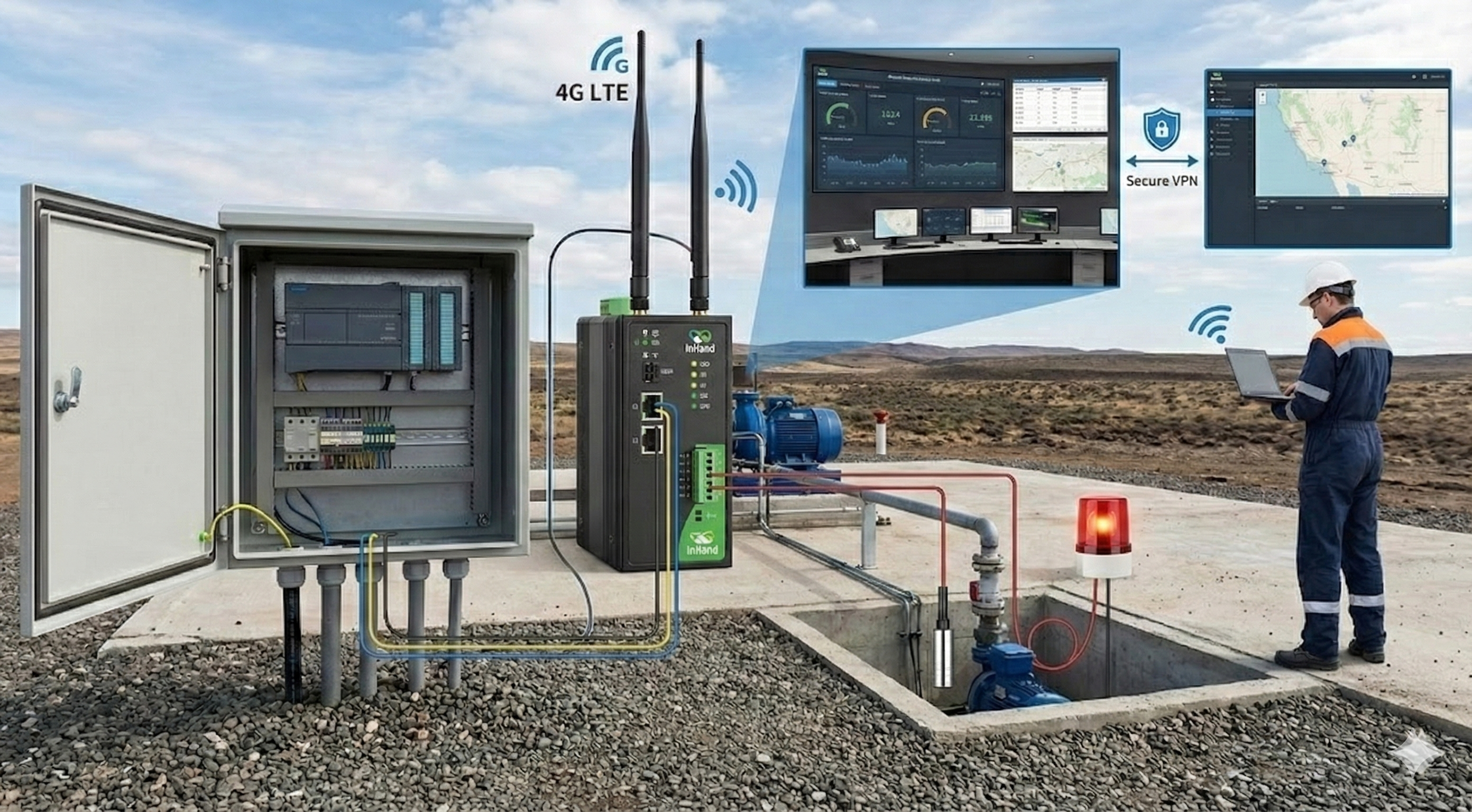
Deploy the InHand IR302 Industrial Router at each pump station. The IR302 acts as the central communication gateway, connecting PLCs (Programmable Logic Controllers), sensors, and alarms to the central SCADA system via a 4G/LTE cellular network.
3. Implementation Details
Step 1: Cellular Network Access
- Since wired internet is unavailable, the IR302 utilizes its 3G/4G cellular capability to provide high-speed network access for the field equipment.
- The Watchdog mechanism and multi-level link detection ensure the router stays online continuously in these unmanned environments.
Step 2: Equipment Monitoring via Serial Port (DTU)
The pump station's PLC is connected to the router's serial port (RS232 or RS485).
- Using the DTU (Data Terminal Unit) function, the router is configured for Transparent Transmission (TCP mode). This allows the serial data from the PLC to be forwarded directly to the data center server without protocol conversion.
Step 3: Remote Control and Alarms via I/O Interfaces
- Input Monitoring (DI): A door sensor or water level switch is connected to the router's Digital Input (DI). If the door is forced open or the water level hits a critical point (0-30V input range), the router detects the status change.
- Output Control (DO): An external relay is connected to the Digital Output (DO). In an emergency, operators can remotely trigger the DO (which outputs a high level of 12V) to activate the relay. This relay can turn on a warning light or cut off power to a pump.
Step 4: Secure Data Transmission (VPN)
- To protect the critical infrastructure data, an IPSec VPN tunnel is established between the IR302 and the central monitoring center.
- This ensures data integrity and confidentiality using encryption algorithms (e.g., 3DES, AES) during transmission over the public internet.
Step 5: Wi-Fi for On-Site Maintenance
- The IR302 is configured in WLAN AP mode. When maintenance personnel visit the site, they can wirelessly connect their laptops to the router to check logs or debug the PLC, avoiding the need to physically plug into the cabinet.
4. Benefits
- Cost Reduction: Eliminates the high cost of laying cables to remote areas by using 4G networks.
- Real-time Response: The I/O ports allow for immediate remote control (e.g., activating relays) without sending a technician to the site.
- High Reliability: The device is designed for unmanned sites with self-recovery features (Watchdog) to prevent downtime.
- Enhanced Security: VPN protocols prevent unauthorized access to the pump control systems.
Topic Participants
david.jing